Author: Juan Vasquez

  • Tips that can lower the likelihood of having your WordPress site Hacked

    Tips that can lower the likelihood of having your WordPress site Hacked

    hacked

    WordPress is one of the easiest content management systems to set up and use. That’s why people like it. It’s easy to add functionality without having to know how to code php because there is such a large developer community that makes tons of free plugins. WordPress is the largest self-hosted blogging platform in the world, powering more than 60 million websites worldwide.

    That fact may be a key reason why WordPress is in the news right now as the subject of a large-scale attack from a huge number of computers from across the internet – known as an automated botnet attack – attempting to take over servers that run WordPress.

    WordPress’ popularity comes at a price in a situation like this, as a perceived vulnerability in the platform’s ease of use is weak security by users. If you or your company have sites that use WordPress, there are two things to consider. First is to avoid having your own site hijacked and second is to avoid becoming part of a larger problem. Think childhood immunizations.

    So what can you do to make your site secure enough right now to deter such attacks in the future?

    Avoid Obvious Passwords: Hackers mostly go after novice Web users who don’t take the time to switch from their default login information. A secure password is a mix of at least eight upper and lowercase letters, numbers and special characters (^%$#@*)!

    Loose The Admin Username: The attackers are in possession of 90,000 IP addresses from which they are trying to crack the default “admin” accounts on WordPress installations. So if you are still using “admin,” create a new user with admin privileges (you will need to use a different email address than the one attached to the current admin) and give it a strong password as defined above. Then log back in as the new user and delete the old admin account and assign all of the posts in that account to the new user. Five minutes, tops.

    Use Two Step Authentication: Take advantage of two-step authentication which assures that you are a human logging in, not a bot. To enable Two Step Authentication, head on over to the new Security tab in your WordPress.com account settings, and go through the setup wizard. The wizard will help you make sure that everything is configured correctly.

    Update WordPress: Many hackers exploit holes that have been identified in older versions of WordPress, so keeping your install up to date is another easy way to avoid trouble.

    Don’t let spammers, hackers or botnets mess up your presence on the web. You can be secure.

    There’s a lot more you can do to protect your site. Figment Design has amazing security packages to protect your WordPress site from hacking attempts this includes reports on your website security.

  • How to Increase Direct Mail Response Rates

    How to Increase Direct Mail Response Rates

    CreativozStationeryBetter Results, Better ROI

    Getting the best possible direct mail piece is crucial to ensure that your direct mail ends up in the hands of the consumer, rather than in the trash.  This is where Variable Data Printing come in.

    Variable Data Printing

    How do you increase response rates on those direct mail pieces without spending a king’s ransom to do it?  Variable Data Printing is how.  It’s always been important to make the customer feel like the piece is mailed just to them, and the offer is just for them.  Address labels that look handwritten have long been a staple in Miami direct mail campaigns.  Variable Data Printing makes it even easier to make your customer feel special.

    By inserting the correct name, images, relevant data about the prospect, and other information, you increase your response rate threefold.  That’s a massive difference in the response to your direct mail campaign, and one that can create explosive direct mail return on investment, without a huge investment!

    Personalizing Appropriate Information

    Having the appropriate information printed directly into the direct mail piece, you can increase your average order size, along with reducing the cost per response.  The combination of the two has a significant impact on your bottom line.  Often, those who respond to a standard direct mail piece might make a purchase once.  By including variable data printing in the direct mail piece, you increase the chances of that person ordering again, because they feel the piece was directed at them personally.

    One of the truly amazing things about variable data printing is that you don’t have to worry about proofs being “off.”  Because of the nature of variable data printing, the proof that you approve is really the first piece of your production-printed direct mail campaign.  It looks exactly like what will be mailed to your customers because it is what will be mailed to your customers!

    Contact us today to find out how the variable data printing technology can reduce your time and cost expenditures while increasing your return.

    [g-gallery gid=”5336″]

  • What is Marketing? How is it different from Branding?

    What is Marketing? How is it different from Branding?

    marketServ

    What exactly is marketing and why is it important to your business?

    Marketing is everything you do to place your product/service in the hands of potential customers and clients.

    It includes diverse disciplines like sales, public relations, pricing, packaging, and distribution.

    You might think of marketing this way. If business is all about people and money and the art of persuading one to part from the other, then marketing is all about finding the right people to persuade.

    Marketing is your strategy for allocating resources (time and money) in order to achieve your objectives (a fair profit for supplying a good product or service).

    Marketing – the management process through which goods and services move from concept to the customer.

    It includes the coordination of four elements:

    identification, selection and development of a product

    determination of its price

    selection of a distribution channel to reach the customer’s place

    development and implementation of a promotional strategy

    Marketing is based on thinking about the business in terms of customer needs and their satisfaction.  It is not concerned with the values that the exchange is all about. And it does not, as marketing invariable does, view the entire business process as consisting of a tightly integrated effort to discover, create, arouse and satisfy customer needs. Marketing has less to do with getting customers to pay for your product as it does developing a demand for that product and fulfilling a customer’s needs.

    What is the difference between marketing and branding?

    There is a spectrum of opinions here, Marketing is actively promoting a product or service.

    It’s a push tactic.
    It’s pushing out a message to get sales results
    This is oversimplification

    This is not branding

    Branding should both precede and underlie any marketing effort.

    Branding is not push, but pull
    Branding is the expression of the essential truth or value of an organization, product, or service
    It is communication of characteristics, values, and attributes that clarify what this particular brand is and is not

    A brand will help encourage someone to buy a product, and it directly supports whatever sales or marketing activities are in play, but the brand does not explicitly say “buy me.” Instead, it says“This is what I am. This is why I exist. If you agree, if you like me, you can buy me, support me, and recommend me to your friends.”

    Branding is Strategic. Marketing is Tactical.

    Marketing may contribute to a brand, but the brand is bigger than any particular marketing effort. The brand is what remains after the marketing has swept through the room. It’s what sticks in your mind associated with a product, service, or organization—whether or not, at that particular moment, you bought or did not buy.

    The brand is ultimately what determines if you will become a loyal customer or not. The marketing may convince you to buy a particular Toyota, and maybe it’s the first foreign car you ever owned, but it is the brand that will determine if you will only buy Toyotas for the rest of your life.

    The brand is built from many things. Very important among these things is the lived experience of the brand. Did that car deliver on its brand promise of reliability? Did the maker continue to uphold the quality standards that made them what they are? Did the sales guy or the service center mechanic know what they were talking about?

    Marketing unearths and activates buyers. Branding makes loyal customers, advocates, even evangelists out of those who buy.

    This works the same way for all types of businesses and organizations. All organizations must sell (including non-profits). How they sell may differ, and everyone in an organization is, with their every action, either constructing or deconstructing the brand. Every thought, every action, every policy, every ad, every marketing promotion has the effect of either inspiring or deterring brand loyalty in whomever is exposed to it. All of this affects sales.

    Branding is as vital to the success of a business or non-profit as having financial coherence, having a vision for the future, or having quality employees.

    Media & Marketing

    Your brand and message may be great
    …but who is seeing it?

    No matter how good your message is, if it doesn’t get in front of the right audience, then it is just a waste. Our CEO likes to say, “don’t advertise a pork chop sale to the pigs, advertise it to the pig farmers!”  Media & Marketing is a main focus here. We not only focus on your message, but that its getting to the audience that will respond and be interested. The days of throwing mud at the side of the building and seeing what sticks is gone, now it is all about the ROI. Let us show you what our media department can do for you: research, media planning, marketing, placement and management.

    Outdoor Media & Signs

    [g-gallery gid=”5341″ random=”0″ watermark=”0″]

    Promotional Items

    [g-gallery gid=”5345″ random=”0″ watermark=”0″]

    Window Wraps

    [g-gallery gid=”5349″ random=”0″ watermark=”0″]

    Vehicle Wraps

    [g-gallery gid=”5347″ random=”0″ watermark=”0″]

  • Have a Nice Weekend – Every Day

    Have a Nice Weekend – Every Day

    We spend five days looking forward to just two. The fact is that most people do what they enjoy most on those two days. Imagine living a life where everyday are your Saturdays and Sundays. Make everyday your weekend. Make everyday count. Don’t let your life pass before your eyes five days at a time.

    Weekend-Banner_262015_IG_2

  • TYPOGRAPHY War of Helvetica vs. Arial

    TYPOGRAPHY War of Helvetica vs. Arial

    ARIAL VERSUS HELVETICA

    Every typeface, like every one of us, has its distinguishing features. You might be forgiven for thinking that some fonts are clones, or identical twins. However, closer inspection reveals subtle differences and nuances that simply escape casual perusal. Something that can really help heighten our sensitivity to those differences is getting out our magnifying glasses and really taking a closer look.

    Today we’re going to de-robe two popular typefaces, namely Arial and Helvetica — faces that are often confused, and often the subjects of mistaken identity. But first let me re-introduce you to these two popular faces:

    Helvetica

    Designed in 1957 by Max Miedinger, Helvetica’s design is based on that of Akzidenz Grotesk (1896), and classified as a Grotesque or Transitional san serif face. Originally it was called Neue Haas Grotesque; in 1960 it was revised and renamed Helvetica (Latin for “Swiss”).

    Arial

    Designed in 1982 by Robin Nicholas and Patricia Saunders for Monotype (not Microsoft), it’s classified as Neo Grotesque, was originally called Sonoran San Serif, and was designed for IBM’s bitmap font laser printers. It was first supplied with Windows 3.1 (1992) and was one of the core fonts in all subsequent versions of Windows until Vista, when to all intents and purposes, it was replaced with Calibri.

    Arial and Helvetica share a more consistent, even stroke width. I guess it depends on whether one is looking at the form or the appearance.

    gqr

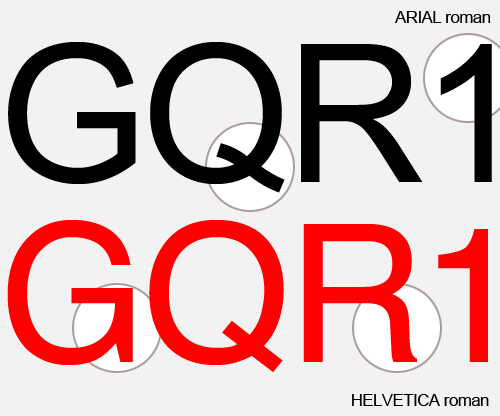
    A number of the glyphs are almost identical, and even an expert would have difficulty telling them apart. However, there are a few that stand out as being quite different; namely “a”, “G”, “Q”, “R”, and “1”. Did you spot any other differences or identifying marks?

    In fact if you wish to quickly differentiate any font from from another, it’s usually best to begin by looking at letters like “J”, “Q” and “g”.

    Arial - Helvetica

    What it’s wrong to do is criticize Arial as a clone or rip-off of Helvetica. If Arial is a rip-off of Helvetica, then Helvetica is a rip-off of Akzidenz Grotesk; or we could simply say that they are both rip-offs of earlier Grotesque faces. The whole rip-off debate is a rather pointless one, I feel. Every face should be considered on its own merit. (We don’t criticize a daughter for looking like her mother). And, if you want to criticize Arial (it certainly has its faults), then do so, not because everyone else does, but do so with your own critical eye.

  • Understanding Google Search Engine Optimization (SEO) for begginers

    Understanding Google Search Engine Optimization (SEO) for begginers

    seo-1

    Found several great articles on getting started with SEO and some of the basic ideas/techniques behind search engine optimization.


    Create unique, accurate page titles

    html-codeA title tag tells both users and search engines what the topic of a particular page is. The <title> tag should be placed within the <head> tag of the HTML document. Ideally, you should create a unique title for each page on your site.  If your document appears in a search results page, the contents of the title tag will usually appear in the first line of the results. Words in the title are bolded if they appear in the user’s search query. This can help users recognize if the page is likely to be relevant to their search.

    The title for your homepage can list the name of your website/ business and could include other bits of important information like the physical location of the business or maybe a few of its main focuses or offerings.

    Accurately describe the page’s content

    • Choose a title that effectively communicates the topic of the page’s content.
    • Avoid:
      • choosing a title that has no relation to the content on the page
      • using default or vague titles like “Untitled” or “New Page 1”

    Create unique title tags for each page

    • Each of your pages should ideally have a unique title tag, which helps Google know how the page is distinct from the others on your site
    • Avoid:
      • using a single title tag across all of your site’s pages or a large group of pages

    Use brief, but descriptive titles

    • Titles can be both short and informative. If the title is too long, Google will show only a portion of it in the search result.
    • Avoid:
      • using extremely lengthy titles that are unhelpful to users
      • stuffing unneeded keywords in your title tags

    Page titles are an important aspect of search engine optimization.


    Make use of the “description” meta tag

    Summaries can be defined for each page

    html codeA page’s description meta tag gives Google and other search engines a summary of what the page is about (1). Whereas a page’s title may be a few words or a phrase, a page’s description meta tag might be a sentence or two or a short paragraph. Google Webmaster Tools provides a handy content analysis section that’ll tell you about any description meta tags that are either too short, long, or duplicated too many times (the same information is also shown for <title> tags). Like the <title> tag, the description meta tag is placed within the <head> tag of your HTML document.

    Description meta tags are important because Google might use them as snippets for your pages. Note that we say “might” because Google may choose to use a relevant section of your page’s visible text if it does a good job of matching up with a user’s query. Alternatively, Google might use your site’s description in the Open Directory Project if your site is listed there (learn how to prevent search engines from displaying ODP data). Adding description meta tags to each of your pages is always a good practice in case Google cannot find a good selection of text to use in the snippet. The Webmaster Central Blog has an informative post on improving snippets with better description meta tags. Words in the snippet are bolded when they appear in the user’s query. This gives the user clues about whether the content on the page matches with what he or she is looking for.

    Accurately summarize the page’s content

    • Write a description that would both inform and interest users if they saw your description meta tag as a snippet in a search result.
    • Avoid:
      • writing a description meta tag that has no relation to the content on the page
      • using generic descriptions like “This is a web page” or “Page about baseball cards”
      • filling the description with only keywords
      • copying and pasting the entire content of the document into the description meta tag

     Use unique descriptions for each page

    • Having a different description meta tag for each page helps both users and Google, especially in searches where users may bring up multiple pages on your domain (e.g. searches using the site: operator). If your site has thousands or even millions of pages, hand-crafting description meta tags probably isn’t feasible. In this case, you could automatically generate description meta tags based on each page’s content.
    • Avoid:
      • using a single description meta tag across all of your site’s pages or a large group of pages

    Use description meta tags to provide both search engines and users with a summary of what your page is about!

    Hope this gives you a basic idea of how to get started, there are many steps to SEO and many techniques out there impossible to list them all but if you at least understand the basics it’s a great start!   If you need help with your sites SEO or do want to do this on your own please do not hesitate to contact us today.

  • The Short Run – Advantages of Digital Printing

    The Short Run – Advantages of Digital Printing

    How Can  Digital Printing Advantages Like Short Run Make Your Business More Efficient?

    printMany people do not understand the advantages of digital printing, especially in Miami. To help clear up some misunderstandings and misconceptions we put together this article for you.  Sometimes, the latest and coolest concepts in printing are appropriate to save you money, get a better response rate, or otherwise improve your ROI.  Other times, you just need something printed as quickly and efficiently as possible, and there are solutions for that as well. You’ve probably heard or said many time; “These have to look professional, but I only need a few!” What do you do when you only need a small quantity printed, but you need so many that the cost of ink and glossy paper for your inkjet would be insane?  Too many to print on an inkjet, too few to have professionally printed?  This is where Digital Printing comes in.

    What is Digital Printing Really?

    Digital printing refers to methods of printing from a digital-based image directly to a variety of media. It usually refers to professional printing where small-run jobs from desktop publishing and other digital sources are printed using large-format and/or high-volume laser or inkjet printers. Digital printing has a higher cost per page than more traditional offset printing methods, but this price is usually offset by avoiding the cost of all the technical steps required to make printing plates. It also allows for on-demand printing, short turnaround time, and even a modification of the image (variable data) used for each impression. The savings in labor and the ever-increasing capability of digital presses means that digital printing is reaching the point where it can match or supersede offset printing technology’s ability to produce larger print runs of several thousand sheets at a low price.

    stluciaad2We’ve given businesses in Miami, FL and around the US a perfect solution.

    That solution is a “short run” using digital printing.  What does short run printing entail?  We prepare the art and we can usually turn it around the same day, regardless of how small your quantity needs may be.  It’s sort of the equivalent of shared office space – you’re only paying for the portion of the printing you use, even if the press is running all day.   You don’t have to buy unnecessary quantities anymore and with a low minimum printing quantity.

    Short Run Digital Printing Is Accessible to Every Business

    Do you need overnight posters?  Do you need table tents or door hangers?  Or something entirely different?  Since we mentioned it, table tents are a perfect example of short run digital printing.  Say an average restaurant has fifty tables and changes their specials posted on the table on a monthly basis.  During that month, customers steal, damage, or otherwise render unusable one per week, per table.  So we’ll take the fifty tables times four weeks in a month, and we find the restaurant needs 200 table tents.  That’s not much to most printers.  You only need to purchase the quantity you need, on a just in time basis.

    [g-gallery gid=”5344″]

  • Happy President's Day

    Happy President's Day

    “Believe that you can and you’re halfway there”
    – Theodore Roosevelt

    President-Day_IG

  • Happy Valentine's Day

    Happy Valentine's Day

    Love is our true destiny. We do not find the meaning of life by ourselves alone – we find it with another.
    -Thomas Merton
    2-Valentine's-Day-2_IG