Tag: seo

  • Why SEO Alone Isn’t Enough

    Why SEO Alone Isn’t Enough

    Why Seo alone isnt enough

    Website traffic is incredibly important to any company. Since almost all consumers conduct some amount of online research when looking for businesses, an increase in website traffic should almost always correspond with an influx of new customers.

    Faced with the need to acquire as much website traffic as possible, it’s likely that you’ve focused much of your digital marketing energy on search engine optimization. SEO, after all, is what brings people to your website. The problem with on-page SEO, though, is that too many business owners focus exclusively on it. Have you ever paused to think about how well your website serves the traffic that it receives? Have you ever considered the fact that building a better relationship with your website’s visitors is actually an SEO skill in itself?

    It’s time to become a more complete online marketer. Search engine optimization alone isn’t enough to make a website successful. We’re going to explain why.

    The User Experience

    When you construct pages on your website, it’s likely that you spend a fair bit of time on aspects that users don’t specifically notice — items such as meta and alt tags, keyword density and PageRank sculpting. However, none of those items contribute directly to the experience that a user has when visiting your website. People visit your website because they want information that only someone with your expertise can provide. If you want your content to lead to the acquisition of new customers, you need to focus on providing a great user experience. In doing so, you’ll also contribute to your website’s search engine ranking. Inbound links factor greatly into a website’s search engine rankings, and few website owners willingly link to mediocre content.

    Addressing Social Media

    While it’s fine to focus your digital marketing energy primarily on your own website, it’s unwise to ignore social media because social network profiles often rank prominently for branded search terms. Google knows that visiting a company’s social network profiles is an important part of the process for many people who research businesses online. Having several active pages on social networks can actually strengthen the search engine ranking of your official website because it tells Google that you are serious about your brand’s identity. Promoting your content on social networks is also an excellent way to increase the content’s reach.

    Conversions Drive Profits

    Search engine optimization helps your website attract traffic, but it doesn’t do anything to help you earn money from that traffic. Even great content doesn’t necessarily help your bottom line. Content engages visitors and establishes your authority and expertise, but content doesn’t drive sales. Building a sales funnel — and encouraging website visitors to enter the funnel — is what ultimately makes your optimization efforts worthwhile. Whether you want website visitors to enter your sales funnel by buying a product immediately, signing up for your mailing list or filling out a form to request an appointment, each piece of content that you publish should include a strong call to action telling the visitor what to do next.

    Elevate Your SEO with Us

    Are you ready to bring your digital marketing skills to the next level? Contact us now for help with search engine optimization, social media promotion, conversion rate optimization or any other form of online marketing.

  • Common Business Website Mistakes

    Common Business Website Mistakes

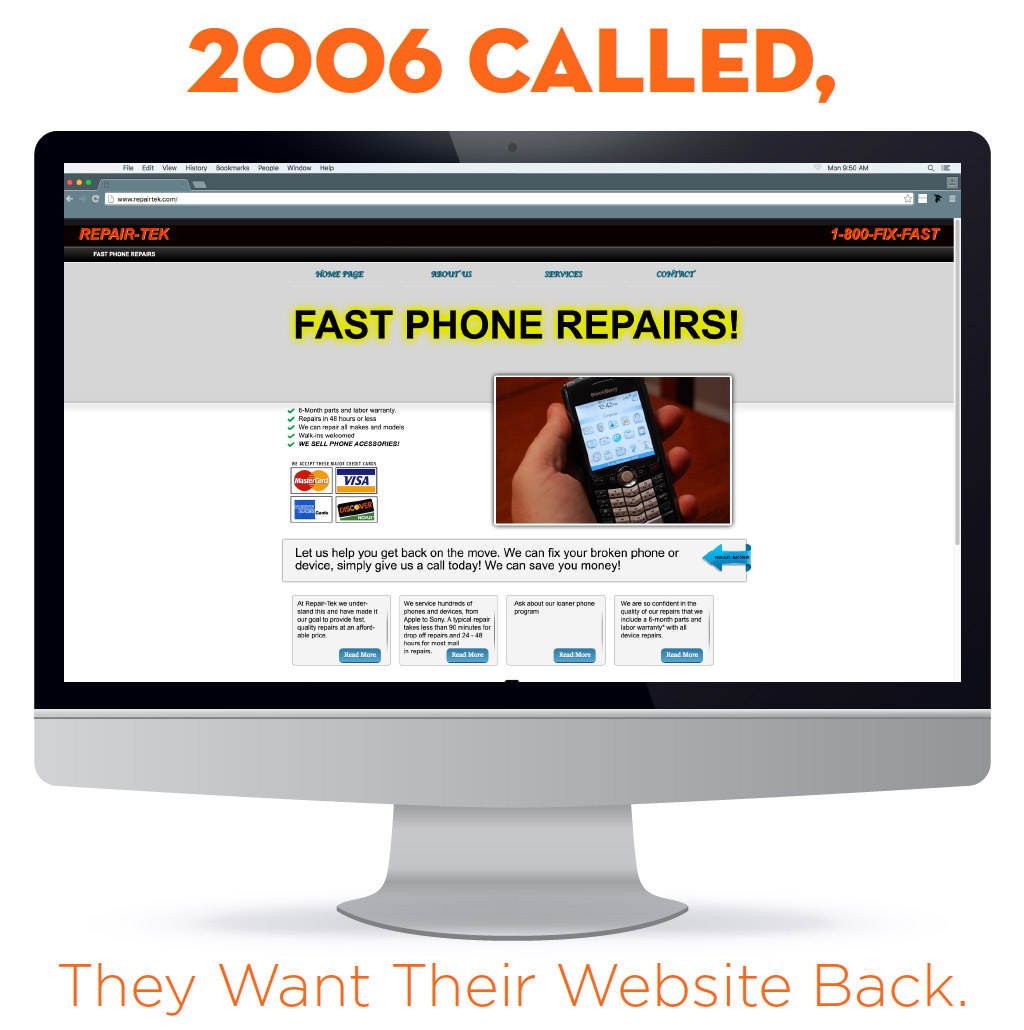
    2006 Called - They want their website back.

    DOES THE WEBSITE HAVE A CLEAR PURPOSE

    Studies have shown that 500 milliseconds (i.e. half a second) is the amount of time needed by a site visitor to be engaged when landing on your page for the first time. That is why it is one should ask, “Does this site pass the blink test?” The blink test determines if a site was created with an eye catching design that communicates its message to customers in a clear and timely manner within the half second rule. It my sound silly but if a visitor is not engaged or the purpose of the sight is not clear, then the visitor is more than likely to leave the site.

    BAD SITE NAVIGATION

    Nothing hampers the user experience more than a poorly designed website. Poorly designed menu system, crowded page layout and poorly defined actionable items.

    Users should not have to toil for the information they came for in the first place.

    Visitors to your site should be presented with an intuitive layout. If your site design is well conceived and provides the user with a good experience, then the user will feel that they are dealing with a reputable business. Steve Krug author of the book “Don’t Make Me Think” states: “I should be able to “get it” – what it is and how to use it – without expending any effort thinking about it.”

    WEBPAGE CLUTTER

    Though it may seem obvious, clutter still happens all too often on websites. This happens when you have too much copy or graphics vying for attention. The end result is usually having the user leaving your site. Strive for a balanced ratio of copy and visual elements.

    MISSING CALLS-TO-ACTION

    Your business site exists for a reason and that is to create customers for you. A mistake that happens often is you have something offered on your site, but the call-to-action for them to take fails to motivate the visitor to click. The lack of a compelling call to action is a sure way to harm the conversion rate of your site. 

     USING FLASH

    It’s a 90s technology that just needs to stay in the 90’s. It’s not compatible with mobile devices and causes problems with web browsers. Websites now use a combination of HTML 5, CCS3 and JavaScript. Those technologies are widely supported on mobile platforms and across many different devices.

    BROKEN LINKS

    Broken links are unacceptable and unprofessional on business websites. This will cause your site not be indexed properly and cause you to loose traffic. It will also frustrate the visitor because it basically sends the user to a dreaded 404 page which the user then has to use the click back button to return the previous page. Broken links also hurt your sites credibility and hurt its SEO page ranking.

     LACK OF SOCIAL MEDIA INTEGRATION

    Social media is an integral part of your online marketing strategy. Social media allows your visitors to engage with your business. Encourage visitors share and publish your content on their social profiles. When visitors create content about your business your also having them create digital word of mouth, which is very valuable to your business. 

    NON RESPONSIVE WEBSITE

    A sure way to shoot your business in the foot in today’s online world is not to have your site be “responsive” in its design. Wikipedia defines Responsive web design as: web design aimed at crafting sites to provide an optimal viewing and interaction experience—easy reading and navigation with a minimum of resizing, panning, and scrolling—across a wide range of devices (from desktop computer monitors to mobile phones).” Mobile traffic is growing more and more every year.

    Over 50% of online traffic now comes from mobile devices. Failure to recognize this feature will put your site at a disadvantage.

    POOR IMAGE QUALITY

    Nobody likes to see low-res jaggy or blurry images. Having sub-par images make your site not only look unprofessional but also hurt your credibility as a business. Quality images are a must for any professional business site. There really isn’t a reason to have bad images on your site when there are many cost effective photo stock sites available online. One needs to make sure that web images load quickly and are optimized for web use. Web graphics should be set to 72dpi and are most likely to be saved in GIF (Graphics Interchange Format), JPEG (Joint Photographic Experts Group) or PNG (Portable Network Graphics) format. GIF format is primarily use for flat colored graphics without graduated colors like photographs. Gifs work better with logos or simple illustrations. Jpegs is used mostly when displaying photographs or other graphics with continuous tones. PNG offer the same GIF capabilities but allow for 24 bit images. You should also resist the urge to put images found using search since you’re the opening yourself to legal copyright infringement issues.

    For more information on how our company can help your business grow please fill out the form below.

  • Why Can’t I Find Myself On Google?

    Why Can’t I Find Myself On Google?

    Lost-in-web

    Your company has just started its first paid search or SEO campaign, and you can’t wait to see results. You may feel the impulse to start Googling brand terms and other keywords to ensure your ads are serving and the copy looks correct. Or maybe you’ll scroll down past the ads to see how your site is ranking in organic search.

    We see this happen all the time, but it’s actually a bad idea to search for yourself to verify your PPC and SEO campaigns. Of all the tools on the Internet, personal search results are perhaps the least reliable performance metrics. In fact, performing these searches actually can do more harm than good. Read on to learn more about why searching for yourself online isn’t a productive way to measure your Internet marketing campaigns.

    How Searching for Yourself Damages Your Business

    At the very least, searching for your ads and clicking through to check the landing page costs money. If you check your ads and the extensions daily on Google and Bing, then you could be wasting more than $500 a year.

    Except for a few brand terms, most of your keywords and campaigns will have an impression share below 100%. This means your ads aren’t showing all of the time due to budget and bidding factors. If you’re constantly searching for your ads, then you’re taking away the opportunity for a customer who actually wants to buy your product to see your branding.

    For both PPC and SEO, these searches hyper-inflate demand for certain terms. While larger businesses won’t have to worry about a few clicks increasing their demand, this is a real problem for companies that only get a few hundred clicks a day.

    Why Your Personal Search Results are Irrelevant

    Most likely, you won’t find any results if you search for yourself or keywords that you feel you should be ranking for. And even if searching for yourself yields amazing results in first position on your computer, it could mean nothing to everyone else — including people in the same geographic location.

    Google is in the business of learning what people want and serving it up on the first try. If the Google algorithm knows that you’re interested in ads or results about your business based on your search history, then Google will show them to you. The search engine doesn’t connect the dots that you work for the company; it just focuses on the demand and CTR.

    Even if you search for your terms without clicking on them, you could be skewing your results in the future. Google will eventually stop serving ads altogether, and assume that you’re the type of user who avoids ads. In this case, your ads are still showing, just not to you — and that’s a direct result of all that self-Googling behavior.

    Finally, searching in incognito won’t make your results any more accurate. Even though Google doesn’t store the search data, the sites you visit are able to.

    You Think Differently than Your Customers

    Just because you optimize for a keyword or bid it to first position doesn’t mean those are the results that you’re showing for. On the PPC side, your match type dictates which searches your ads can be seen. On the SEO side, the odds that people search for your exact keyword before they convert are slim.

    The fact is, your customers don’t think like you do. They make spelling errors and type more naturalistic, query-driven phrases into the search bar. Ultimately, it takes a great deal of experience with paid search and SEO to interpret the data and determine the terms for which your customers are actually searching.

    Unless you know how to properly research keywords based on traffic volume and conversion data, Googling yourself just wastes your time by providing unrealistic results for unrealistic searches.

    3icons

    Valuing the Right Metrics to Achieve Your Business’ Actual Goals

    At the end of the day, Googling yourself and seeing keyword rankings is not the most accurate way to check on the success of a campaign. Agencies that emphasize the importance of finding yourself online usually are optimizing for vanity terms that won’t get any real traffic or generate any actual revenue.

    By contrast, Figments’s main success metric is the number of unique leads being driven to clients. Our Internet marketing campaigns are optimized so that all elements — whether they’re organic or paid search — are coordinated to achieve this end goal. Find out how we can get started doing this for your business today.

    For more information about SEO or how our company can help your business grow please fill out the form below.

  • Your Business: To Be or Not to Be Online?

    Your Business: To Be or Not to Be Online?

    Why Should Your Business Need To Be Online?

    global-smallGiving your small business an online presence means more than simply putting up a website with your address, email and phone number. It means setting up a virtual version of your business, the face and branding of your company and a social presence such as a Facebook page. In this digital era, more people search online for the products and services they need as opposed to searching through a phone book or browsing store to store. Ignoring this reality in marketing is like saying, “I don’t need any new business I’m making the money I want.”

    The Digital Age, A New Economy

    It’s no secret that the Internet has created a new economy. Since 1991 when the NSF first allowed commercial use of the Internet the world changed how it did business. Since then we changed our perception and the way we do business. Think of Jeff Bezos founder of Amazon. He set up his business in his garage. Now his net worth is worth $34.7 billion. There is no doubt that this was all due to his small business having an online presence. However, in order to be successful online, you don’t have to be a giant like Amazon or eBay. Many small and mid-size businesses succeeded in building online businesses quite lucratively. Small and mid-size companies will be the main growth force of e-commerce in the digital age.

    The Internet Is The Perfect Place For Business

    Where do you think more people enter the Target across the street or Target.com? In order to make a sale you need visitors to come to your store. Online there are no lines, no wait, no open and closing hours, no, well you name it. You’re a click away from customers. With proper marketing and a web design company to back you up your Internet storefront can have more buyers than you ever can get in a physical shop.

    Low Start Up Cost

    How much does a store cost these days? Building a website doesn’t require that kind of investment. There are many tools available for small business owners that won’t leave you hurting in the bank. Tools like WordPress can help your business get a boost online. With a good web design company, you can have a site build in a relative short amount of time. Not bad for opening your business to the world.

    Business 24/7

    Could you be at work 24 hours a day 7 days a week? Well you can if your store was online. The biggest advantage of online shops is that they are open 24 hours a day, 7 days a week, 365 days a year. Your online store never closes, never takes coffee breaks, doesn’t have vacation time, doesn’t take lunch breaks and doesn’t complain about pay. Your store is open while you sleep and you can sleep sound that you have a web team behind it, protecting it.

    Corporate Image

    Today everyone has a digital presence. We are all on Facebook, Twitter, Instagram, etc. Even your Corporation has a digital image. Whether you sell a product or a service you have a presence on the Internet. Those that don’t have a presence on the Internet are under the illusion that they have a business when in reality they aren’t even in the sights of the competition. For example, if you have a company that sells electronics but isn’t online, how can it compete with the Best Buy and the TigerDirect down the corner? Most people don’t take you seriously when they ask you for your business’ website and you don’t have one. A nice corporate site definitely increases the image of a company, especially if it has great product or service related content to go with it as well as good SEO.

    www-fiPhysical Presence Anywhere

    Imagine being on your vacation on the beaches of Hawaii and knowing your business is running just fine. The Internet allows you to do business from any part of the world. Your physical location, except for few cases is not that important since you conduct your business online. Your portal to the world is on the palm of your hands.

    Provide Better Customer Support

    Business owners can’t control how good of a day an employee or a customer is having. When the customer visits the store and has a bad experience it’s mostly out of the owner’s hand. Thanks to the Internet, business can provide customer support and care more effectively. This means better customer satisfaction and increase of profitability. When connecting your site with your social media such as Facebook you can keep connected with your customer base. You’ll have more accurate feedback from the people you’re trying to attract to your business.

    Information Easily Available To Customers

    How can you give a present to a customer? In old times companies used to require days to deliver products or services or up to date information to their customers. This is not the case anymore. Now you can add or make any changes to your company and product related content virtually in a matter of hours. Publish on your site and share with the whole world the latest news to your customers.

    Reduce Costs

    Your online presence helps you streamline the business process. This allows you to cut costs in almost every aspect of your business. Companies reduce their maintenance, repair, and even the cooperation costs by using e-business solutions such as online shopping carts. No more slip and fall frivolous lawsuits.

    Global Presence

    If you open your pharmacy and they put a Walgreens and a CVS on each side can you compete with them? Thanks to the Internet, you instantly become a global player. You don’t have to invest large amounts of money opening up your business in every corner. Your business has a radius of action; the online world gives you a global radius.

    Have your business online before you are out of business.

    The longer you wait to have an online presence the harder it’s going to be for you to reach your customers. In the long run do you think more people are going to buy at the corner store or on an online company? If not you then think of the next generation who’ll be the consumer base of the future. Are they buying everything online now? How about 5 years from now? Take your business to the next level. Find yourself a web design and marketing company and give your business the advantage it needs.

  • How WordPress Is Changing The Fashion Industry

    How WordPress Is Changing The Fashion Industry

    fashion-wordpress

    WordPress & The Fashion Industry

    People often make the mistake of classifying WordPress as just a blogging platform. Although that used to be true in the past, WordPress has evolved throughout the years into a versatile content management system (CMS). While you can still use WordPress to create a simple blog, now it also allows you to create fully functional websites and mobile applications.

    The best part about WordPress is that it’s easy to use and flexible enough for just about anything. That’s the main reason why WordPress has grown so much in popularity. WordPress and CMS platforms have changed the world of Fashion. It has taken the place of the old Flash sites and static HTML to bring together interactivity and easy of use for the Fashion Industry. Some time ago WordPress was associated with just blogs. Today it has boomed into a strong tool for just about any type of website.

    Flash sites were the norm and the #1 choice when it came to fashion designer’s choice. This was due largely in part to the animated graphics which Flash has been largely identified with. One of the main problems that it had was ease of use/editing and SEO. Flash made it difficult for users to show up in search engines like Google, Yahoo or Bing.

    everafter-website

    Advantages of WordPress vs Flash Websites

    1. Save Money– You can make most changes to your site or even have your own staff add new pages for you. You can make the edits yourself whenever you want to save time and money especially if these changes are urgent and do not have time to wait on emails.
    2. Greater Accessibility– Make changes or add content from any computer in the world with Internet access and a browser without the need for additional software.
    3. Speed of Communication– At least for simple changes, you don’t need to wait for your webmaster or designer to make those basic changes, the content on your Web site can be altered immediately by you.
    4. Consistency – By following a basic structure or design, no matter how many pages you add the site can keep a consistent look and feel.
    5. Better Time Management– Add content and then schedule those pages/posts. You could write an entire season worth of posts on the site and automatically have them scheduled for a specific day or time.
    6. Ease of Membership Site Rollout– With the addition of a few plugins, a WordPress blog can evolve into a full-service membership site with as many levels as you would like.
    7. Social Network Friendly– Integrate your sites posts with social media like Twitter, Facebook, Linkedin, Pinterest, Instagram, YouTube.
    8. Engage with Current Media– Easily add audio and video to posts and pages.
    9. Creative Welcoming– Integrate new designs faster in comparison to other CMS (Content Management System).
    10. SEO Friendliness– The construction of WordPress is streamlined without excessive HTML code that Google finds very attractive for indexing. With the right setup, you’re able to customize every page or post you make to give you the highest advantage of getting your pages in search results positions.

    fashion-web
    Another reason that WordPress is great for the Fashion industry is that it is written using standard compliance high-quality code and produces semantic mark up. What does that mean? It makes your site very attractive to search engines such as Google. By design, WordPress is SEO friendly, and you can make it even more SEO friendly by using additional WordPress SEO plugins.

    The Fashion industry is a fast-paced and media heavy industry. It needs to be on the cutting edge and have the latest and the greatest as fast as possible. WordPress is not just limited to writing text only. It comes with built-in support to handle images, audio, and video content. It can also easily be used for document or file management. WordPress supports embed YouTube videos, Instagram photos, Tweets, and Soundcloud audio by just pasting the URL in your post. This helps manage the amount of media that the Fashion industry is accustomed to.


  • Understanding Google Search Engine Optimization (SEO) for begginers

    Understanding Google Search Engine Optimization (SEO) for begginers

    seo-1

    Found several great articles on getting started with SEO and some of the basic ideas/techniques behind search engine optimization.


    Create unique, accurate page titles

    html-codeA title tag tells both users and search engines what the topic of a particular page is. The <title> tag should be placed within the <head> tag of the HTML document. Ideally, you should create a unique title for each page on your site.  If your document appears in a search results page, the contents of the title tag will usually appear in the first line of the results. Words in the title are bolded if they appear in the user’s search query. This can help users recognize if the page is likely to be relevant to their search.

    The title for your homepage can list the name of your website/ business and could include other bits of important information like the physical location of the business or maybe a few of its main focuses or offerings.

    Accurately describe the page’s content

    • Choose a title that effectively communicates the topic of the page’s content.
    • Avoid:
      • choosing a title that has no relation to the content on the page
      • using default or vague titles like “Untitled” or “New Page 1”

    Create unique title tags for each page

    • Each of your pages should ideally have a unique title tag, which helps Google know how the page is distinct from the others on your site
    • Avoid:
      • using a single title tag across all of your site’s pages or a large group of pages

    Use brief, but descriptive titles

    • Titles can be both short and informative. If the title is too long, Google will show only a portion of it in the search result.
    • Avoid:
      • using extremely lengthy titles that are unhelpful to users
      • stuffing unneeded keywords in your title tags

    Page titles are an important aspect of search engine optimization.


    Make use of the “description” meta tag

    Summaries can be defined for each page

    html codeA page’s description meta tag gives Google and other search engines a summary of what the page is about (1). Whereas a page’s title may be a few words or a phrase, a page’s description meta tag might be a sentence or two or a short paragraph. Google Webmaster Tools provides a handy content analysis section that’ll tell you about any description meta tags that are either too short, long, or duplicated too many times (the same information is also shown for <title> tags). Like the <title> tag, the description meta tag is placed within the <head> tag of your HTML document.

    Description meta tags are important because Google might use them as snippets for your pages. Note that we say “might” because Google may choose to use a relevant section of your page’s visible text if it does a good job of matching up with a user’s query. Alternatively, Google might use your site’s description in the Open Directory Project if your site is listed there (learn how to prevent search engines from displaying ODP data). Adding description meta tags to each of your pages is always a good practice in case Google cannot find a good selection of text to use in the snippet. The Webmaster Central Blog has an informative post on improving snippets with better description meta tags. Words in the snippet are bolded when they appear in the user’s query. This gives the user clues about whether the content on the page matches with what he or she is looking for.

    Accurately summarize the page’s content

    • Write a description that would both inform and interest users if they saw your description meta tag as a snippet in a search result.
    • Avoid:
      • writing a description meta tag that has no relation to the content on the page
      • using generic descriptions like “This is a web page” or “Page about baseball cards”
      • filling the description with only keywords
      • copying and pasting the entire content of the document into the description meta tag

     Use unique descriptions for each page

    • Having a different description meta tag for each page helps both users and Google, especially in searches where users may bring up multiple pages on your domain (e.g. searches using the site: operator). If your site has thousands or even millions of pages, hand-crafting description meta tags probably isn’t feasible. In this case, you could automatically generate description meta tags based on each page’s content.
    • Avoid:
      • using a single description meta tag across all of your site’s pages or a large group of pages

    Use description meta tags to provide both search engines and users with a summary of what your page is about!

    Hope this gives you a basic idea of how to get started, there are many steps to SEO and many techniques out there impossible to list them all but if you at least understand the basics it’s a great start!   If you need help with your sites SEO or do want to do this on your own please do not hesitate to contact us today.

  • Mobile to pass desktop in search next year, if not already!

    Mobile to pass desktop in search next year, if not already!

    mobile-seo

    Let it be known that mobile devices will lead all search activity in 2015!

    According to a new eMarketer report, “Key Digital Trends for 2015: What’s in Store—and Not in Store—for the Coming Year,” the mobile revolution already well underway will earn smartphones and tablets leadership in generating spend, organic traffic and paid clicks through search queries.

    A word of caution to marketers: mobile return on investment (ROI) analytics still have room for improvement. Future performance measurement tools will need improved precision in order to determine the impact on sales, particularly in physical stores.

    We all know smartphones aren’t going anywhere, meaning the answer to almost any curiosity will always be within close reach. To make it even easier, voice-operated assistants like Siri, Google Now, and Cortana provide a touch-free search experience. The ever-important search function of our phones and tablets will make this trend one to watch.

  • What is canonical and why should I use it

    What is canonical and why should I use it

    canonical htmlHinting to Search Engines the Preferred Version of a Document.

    When you run a data driven site or have other reasons why a document might be duplicated it’s important to tell search engines which copy is the master copy, or in the jargon, the “canonical” copy. When a search engine indexes your pages it can tell when content has been duplicated. Without additional information, the search engine will decide which page best meets the needs of their customers. This might be fine, but there are many instances of search engines delivering old and outdated pages because they chose the wrong document as canonical.

    It is very easy to tell search engines the canonical URL with meta data in the HEAD of your documents. Put the following HTML near the top of your HEAD element on every page that is not canonical:

    <link rel="canonical" href="URL of the canonical page">

    If you have access to the HTTP headers (such as with .htaccess or PHP) you can also set the canonical URL on files that don’t have an HTML HEAD, like a PDF. To do this, set the headers for non-canonical pages like this:

    Link: <URL of the canonical page>; rel="canonical"

    Read The Full Article Here